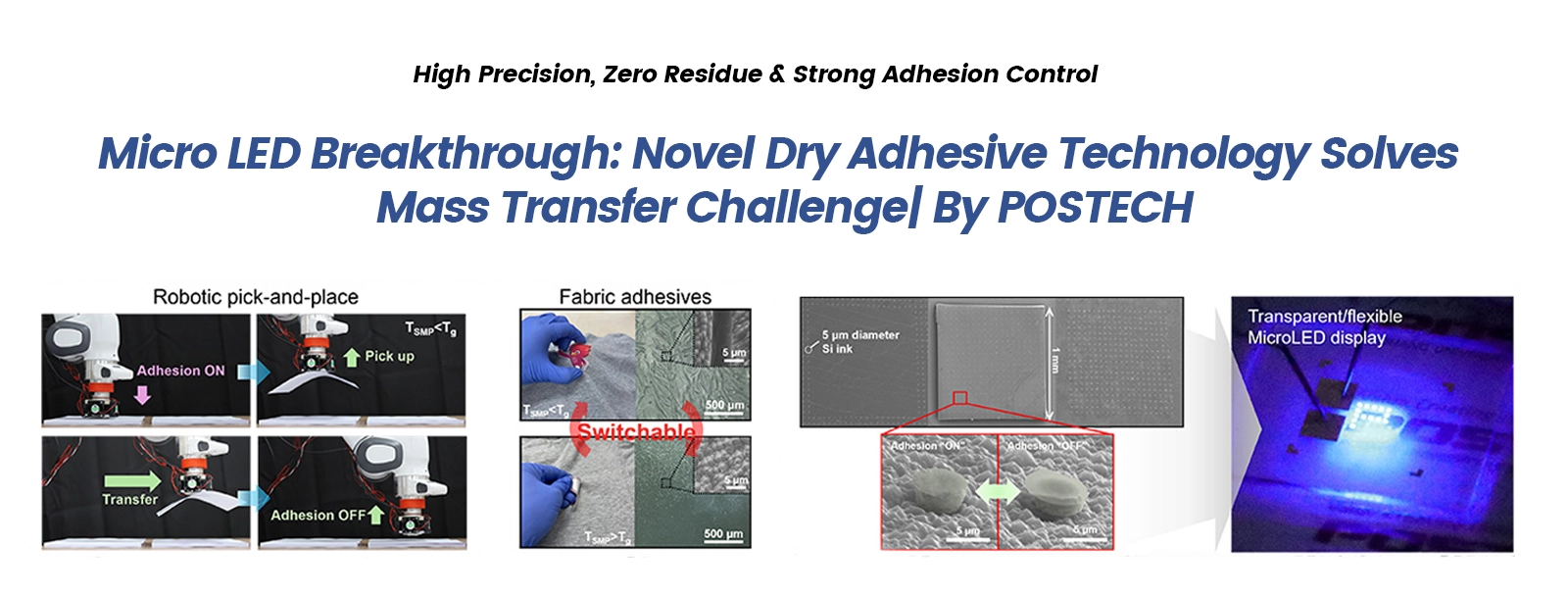
On June 30, foreign media reported that a research team from Pohang University of Science and Technology (POSTECH) in South Korea has recently developed a novel dry adhesive technology, which is expected to solve the problem of high-precision transfer of Micro LED chips. The achievement has been published in the international authoritative journal Nature Communications.
The article introduces that Micro LED, as a new generation of display technology, has multiple advantages such as high brightness, long lifespan, and the ability to achieve flexible and transparent displays. However, efficiently and accurately transferring Micro LED chips (with a diameter smaller than a human hair) onto target substrates has long been a technical bottleneck in the manufacturing process.
Traditional transfer methods mainly rely on liquid adhesives or functional films, which are not only cumbersome in steps but also prone to misalignment, residual contamination, and other issues, making them difficult to meet the industrial requirements of high-end displays and semiconductor packaging.
To overcome this challenge, the POSTECH research team developed a nano-tip structured adhesive material based on “shape memory polymers (SMP)” under the principle of the “adhesion paradox” – theoretically, atoms should have strong adsorption, but in reality, due to high surface roughness, the actual contact area is limited, making it difficult to form strong adhesion.
The core advantage of this new technology lies in the material’s surface, which is microscopically rough at room temperature with extremely weak adhesion. When heated and pressed, the polymer’s “memory” structure deforms, making the surface smooth and instantly enhancing adhesion. Upon reheating, the material reverts to its original state with nearly zero adhesion, allowing easy detachment.
Experiments show that this technology can provide an adsorption force of over 15 atmospheres in the adhesive state, with almost no residual force during detachment. The difference in adhesion strength exceeds 1000 times, far superior to existing technologies.
The research team successfully demonstrated the application of the new dry adhesive technology in high-precision picking and placing of Micro LED chips using a robotic system, and it also showed good adaptability to daily materials such as paper and cloth.
The research team stated that this technology enables precise manipulation of small components without relying on traditional adhesives. If combined with intelligent manufacturing systems in the future, it may play an important role in multiple industrial fields such as display panels and semiconductor packaging. This achievement not only solves the key problem in miniature LEDs mass production but also opens new possibilities for the application of novel dry adhesive materials in cutting-edge fields such as flexible electronics, wearable devices, and automated assembly.