Industry Trends & Cutting - Edge Technologies

The New Landscape of Trade LED Development

  |  
Posted by ym

1. Accelerated Phase-Out of Incandescent Lamps: Trade LED Lighting Enters Replacement Window

The EU has officially announced a complete ban on the sale and use of mercury-containing fluorescent lamps starting February 2025. This move marks the gradual withdrawal of mercury-containing fluorescent tubes from the market, providing vast room for more environmentally friendly and efficient Trade LED light sources. As global “de-incandescent” processes accelerate and green low-carbon policies are densely implemented, the Trade LED lighting industry is ushering in an unprecedented development opportunity. For LED lamp bead manufacturers and smd led wholesalers, how to seize emerging market dividends and address green compliance challenges? This article provides an in-depth analysis of key policy trends and market opportunities.

China and Western countries' phased incandescent lamp phase-out roadmap and timeline comparison.

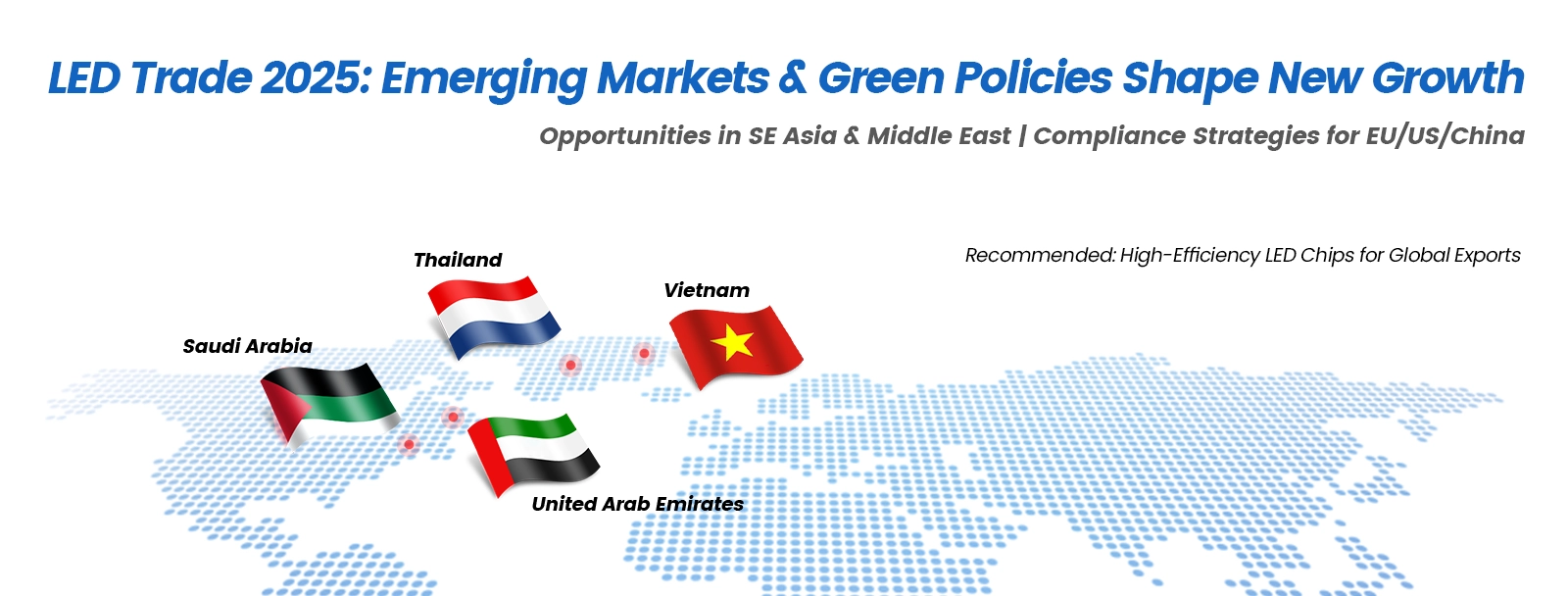
2. Policy Support for Emerging Markets (Southeast Asia, Middle East): Subsidies and Tariff Preferences

⑴ Southeast Asian Market

①Tariff Preferences

  • Thailand: Zero tariffs have been implemented for some exports between China and Thailand. Chinese enterprises, including smd led wholesalers, can enjoy zero-tariff policies when entering the ASEAN market (tariff preferences among ASEAN member states).
  • Vietnam: A comprehensive zero-tariff policy for general products has been in place since 2017. China and Vietnam signed a “Memorandum of Understanding on Supply Chain Cooperation” to promote technological cooperation, helping Chinese smd led wholesalers undertake orders through Vietnamese subsidiaries and avoid tariff barriers (e.g., in the North American market).

② Tax Subsidies

Vietnam: Offers “four-year exemption and nine-year halving” tax incentives for foreign-invested enterprises (exemption for the first 4 years, 50% reduction for the next 9 years). Enterprises in industrial parks can enjoy low tax rates of 10%-17%, benefiting smd led wholesalers.

③ Market Access Support

Thailand: Visa-free travel between China and Thailand for citizens has been implemented since 2024, facilitating business exchanges. The Thai government promotes energy conservation and environmental protection policies, supports the application of Trade LED lighting products, and accelerates the penetration rate of the Trade LED market (projected CAGR of 23.38% from 2022 to 2027).

⑵ Middle Eastern Market

① Tariff Reductions

GCC Countries: China and the Gulf Cooperation Council (GCC) have signed a free trade agreement, reducing tariffs on cross-border goods by over 90%. Coupled with visa-free policies (full coverage of visa exemption between China and GCC countries), this forms a “triple dividend” of talent flow, logistics, and capital flow, benefiting Trade LED exporters.

② Market Demand Drivers

Infrastructure and Consumer Demand: The Middle East (e.g., Saudi Arabia, UAE) has a strong demand for lighting equipment due to population growth, booming tourism, and infrastructure projects (such as Saudi Arabia’s “Vision 2030” and Dubai’s new city projects). China is the largest trading partner of the Middle East in lighting equipment (accounting for about 1/3 of total imports), with Trade LED products becoming the main import category due to their high cost performance (30% lower than European and American prices).

3. Environmental and Green Policies

⑴ EU “Circular Economy” Strategy: Trade LED Product Recycling Requirements

he EU, centered on the “circular economy,” has clarified the whole-life-cycle recycling responsibilities for Trade LED products through policies such as the “Ecodesign for Sustainable Products Regulation” (ESPR) and the “Waste Electrical and Electronic Equipment Directive” (WEEE). Key requirements include:  Extended Producer Responsibility (EPR)

Manufacturers, importers, and distributors (including smd led wholesalers) are responsible for the waste phase of Trade LED products. They must register with local recycling systems (e.g., Germany’s EAR, France’s Screlec), declare sales data, and pay recycling fees. For example, Trade LED lamps must be labeled with the WEEE recycling symbol (trash can with a cross), or注明 in instructions or packaging if direct labeling is not possible.

⑵ China’s “Dual Carbon” Goals: Industrial Lighting Energy Efficiency Improvement

China, targeting “carbon peak by 2030 and carbon neutrality by 2060,” promotes industrial lighting energy efficiency upgrades through policies such as the “Industrial Energy Efficiency Improvement Action Plan” and the “Carbon Peak Action Plan Before 2030.” Specific measures include: Energy Efficiency Standards and Technology Promotion

  • Mandatory use of high-efficiency Trade LED lamps (e.g., luminous efficacy ≥ 120lm/W) in industrial lighting, phasing out inefficient fluorescent lamps and incandescent lamps;
  • Promotion of intelligent control systems (e.g., sensor dimming, IoT linkage) to achieve “on-demand lighting” and reduce energy consumption.

⑶ US DOE Certification: Trade LED Energy Efficiency Subsidy Policies

The U.S. Department of Energy (DOE) promotes the energy efficiency of Trade LED products through mandatory energy efficiency certification and subsidy policies. Key contents include:

① Mandatory DOE Certification Requirements

Trade LED products must comply with 10 CFR 429/430 regulations, pass energy efficiency tests (e.g., luminous efficacy ≥ 45 lm/W), and register with the DOE system; otherwise, sales in the U.S. are prohibited (platforms like Amazon will compulsorily remove uncertified products from 2025). smd led wholesalers must ensure compliance to access the U.S. market.

② Energy Efficiency Subsidies and Tax Incentives

Trade LED products certified by DOE are eligible for federal/state subsidies (e.g., $5-10 per lamp in California), and enterprises can apply for tax credits (e.g., the Inflation Reduction Act provides 30% tax reduction for energy-efficient equipment), benefiting smd led wholesalers and end-users.

The EU strengthens recycling systems through “Extended Producer Responsibility,” China drives industrial lighting energy efficiency upgrades with “Dual Carbon” goals, and the U.S. promotes Trade LED popularization via mandatory certification and subsidies. Together, they reflect the global emphasis on green and low-carbon development. Enterprises, especially smd led wholesalers, must keep up with policy requirements and enhance competitiveness through technological innovation and compliance management.

We value your privacy

We use cookies to enhance your browsing experience, serve personalised ads or content, and analyse our traffic. By clicking "Accept All", you consent to our use of cookies.