


Common Anode RGB LED vs Common Cathode RGB LED: 5050 SMD Pinout and Buying Guide
25 June, 2026
LED lighting, with its advantages of high efficiency, energy saving, and long lifespan, has been widely used in commercial spaces, homes, and other scenarios. However, to keep LEDs shining brightly (led light shining) and maximize their service life (led lifespan/led bulb lifetime), scientific maintenance (led maintenance) and system design are essential. This article will provide a full-process guide for commercial LED lighting (commercial led lighting maintenance), covering core components of LED lighting systems, thermal management (led heat), and specific maintenance tips.
An LED light is not a single component but a system where multiple parts work together. For factories/users purchasing LED beads, understanding the role of each component is key to selecting high-quality lighting fixtures:
As the “heart” of an LED light, the bead directly converts electrical energy into light energy. Its quality determines brightness, color temperature, and lifespan. Common packaging forms (surface-mounted, through-hole, etc.) need to match the design requirements of the lighting fixture. High-quality beads reduce light decay and extend overall lifespan.
LEDs generate heat during operation. The heat sink (made of aluminum/copper) reduces the temperature of the bead through rapid heat conduction, preventing damage from overheating. In high-temperature environments (e.g., commercial kitchens), a high-quality heat sink is critical for maintaining stable operation of the lighting fixture.
The driver converts alternating current (AC) to direct current (DC) required by the LED and stabilizes voltage/current. A high-quality driver with over-current and over-voltage protection can handle voltage fluctuations (e.g., lightning strikes, unstable power grids), directly affecting the brightness stability and lifespan of the lighting fixture.
Components such as the lampshade (light-transmitting and dust-proof), circuit board (support and heat dissipation), and lamp base (power connection) work together to optimize lighting effects (e.g., uniform light output) and user experience.
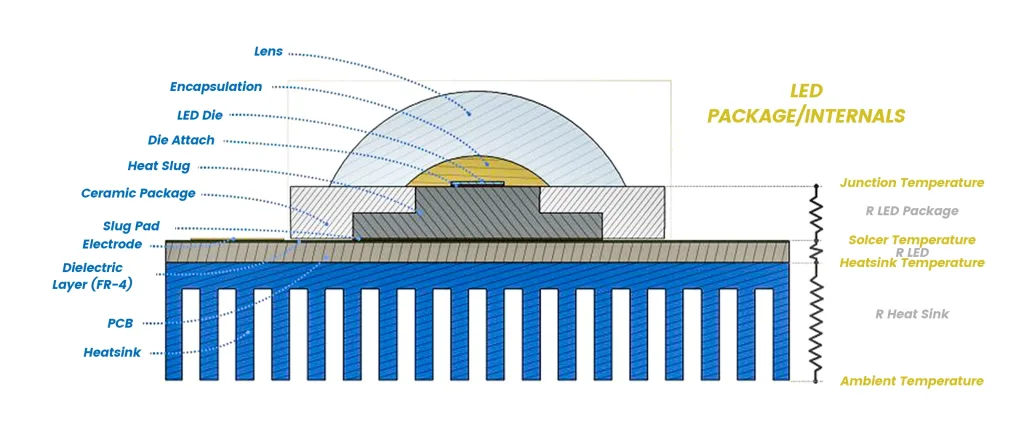
LED light output decreases significantly with rising temperature – for every 10°C increase in temperature, lifespan may be shortened by 50%! Therefore, controlling heat (led heat) is the core of LED maintenance:
Dust accumulation reduces LED brightness and hinders heat dissipation. Use a soft cloth (avoid chemical solvents) to periodically wipe the lamp surface, especially the lampshade and heat sink.
Ensure the installation environment of the lighting fixture is well-ventilated, and avoid enclosed spaces (e.g., small lamp grooves); in commercial scenarios, choose fixtures with independent heat dissipation holes.
Voltage fluctuations are an “invisible killer” for LEDs. Installing a voltage stabilizer or surge protector can effectively handle issues such as lightning strikes and unstable power grids.
Frequent switching accelerates driver aging. It is recommended to use smart dimmers, like PWM dimming, to adjust brightness instead of repeated switching, reducing wear and tear.
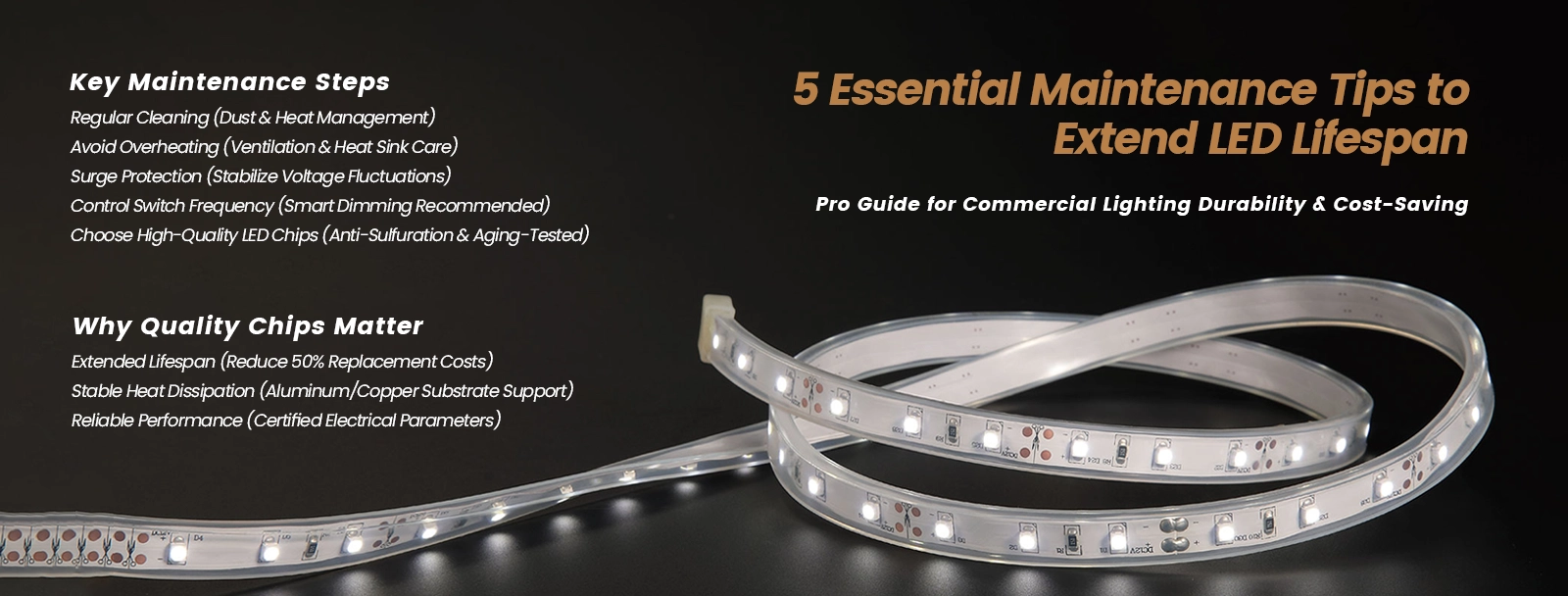
As the core of the system, the quality of the bead directly affects lifespan. When purchasing, pay attention to electrical parameters (e.g., rated current) and packaging processes (e.g., anti-sulfuration capability), and prioritize brand beads that have undergone aging tests.
The long-term stable operation of commercial LED lighting (commercial led lighting maintenance) relies on the dual guarantee of “high-quality components + scientific maintenance”. As an LED bead manufacturer, we are committed to improving the light efficiency, heat dissipation, and lifespan of beads to help you create more durable and efficient lighting systems.