


Common Anode RGB LED vs Common Cathode RGB LED: 5050 SMD Pinout and Buying Guide
25 June, 2026

When tombstoning issues spike on your SMT line, most teams immediately blame the assembly process—but what if the real problem walked in with your latest SMD LED shipment? Poor component quality from suppliers accounts for 40% of tombstoning defects, costing manufacturers $15,000 to $50,000 annually in rework and scrap. Smart procurement teams know that a 2-cent difference in unit price means nothing when defect rates jump from 0.3% to 3%, turning apparent savings into hidden costs that impact your entire operation.
Poor termination quality causes 30-40% of tombstoning defects. When LED terminals have uneven plating or sit at different heights, one side melts before the other during reflow—that’s what makes components flip upright.
Two measurements separate reliable suppliers from problematic ones:
| Specification | Minimum Requirement | Why It Matters |
| Coplanarity | ≤0.05mm | Ensures both terminals sit flat on solder pads; beyond this tolerance, tombstoning risk increases sharply |
| Process Capability (Cpk) | ≥1.33 | Indicates consistent manufacturing; below 1.0 means frequent out-of-spec components |
Before placing orders, request these three critical documents:
Ask these during your qualification calls:
“What’s your Cpk for coplanarity over the last six months?”
Quality-focused suppliers track this continuously and answer with data immediately. Hesitation or vague responses indicate poor process control.
“Can you share assembly defect data from other customers?”
Reputable suppliers collect feedback from manufacturing partners and discuss typical defect rates openly. This shows they understand real-world SMT challenges.
“What inspection systems do you use for terminal quality?”
Manual visual checks miss coplanarity problems. Look for automated optical inspection (AOI) or 3D measurement systems that check every component, not random samples.
Verify these three requirements before adding any LED supplier to your approved vendor list:
□ Certificate of Conformance (CoC) with actual measurements: Must include coplanarity data for each production lot, not generic compliance statements
□ Automated inspection capability: 100% inspection catches defects that manual spot-checks miss; ask what percentage of production gets automated testing
□ MSL rating and handling procedures: Moisture-related soldering problems often look like termination defects; proper documentation prevents misdiagnosis
Suppliers who won’t share this data or call their inspection methods proprietary should raise red flags. Quality manufacturers understand that transparent component specifications directly support your assembly success and are willing to provide documentation that proves their capabilities.

Incompatible components can cost $5,000 to $20,000 in unplanned process adjustments, equipment changes, and production delays. A supplier might offer LEDs at an attractive price, but if their components require non-standard reflow profiles or special handling, those savings disappear quickly.
Request these specifications before committing to a new supplier:
Responsive technical support directly impacts your production uptime. Test suppliers during qualification:
| Supplier Type | Unit Price | Defect Rate | Reality |
| Low-cost supplier | $0.08 | 3% | Hidden rework costs, process adjustments, delayed launches |
| Quality supplier | $0.10 | 0.3% | Stable yields, predictable costs, faster time-to-market |
That 2-cent price difference becomes irrelevant when you factor in rework labor, scrap costs, and production delays. Quality components with proper technical support deliver 15-25% lower total cost of ownership.
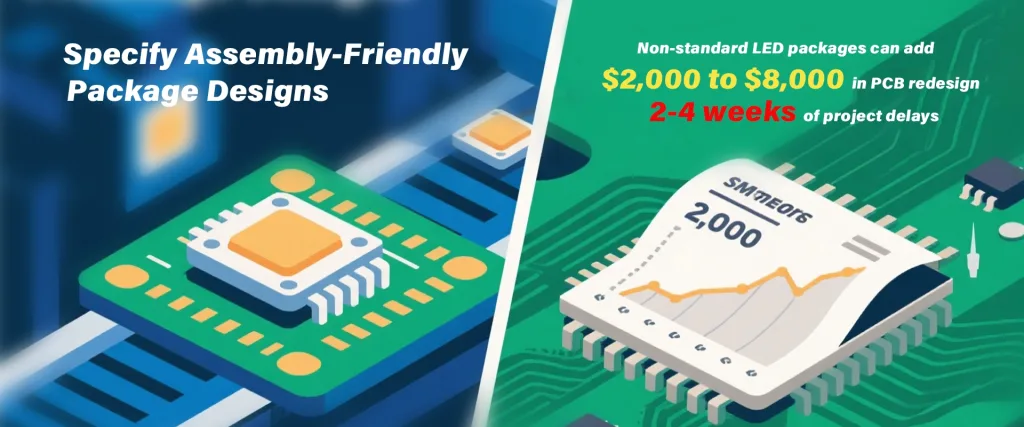
Non-standard LED packages can add $2,000 to $8,000 in PCB redesign costs plus 2-4 weeks of project delays. What looks like a cost-saving component choice often becomes an expensive bottleneck when your design team discovers compatibility issues.
Prioritize these design characteristics when evaluating SMD LED suppliers:
Before selecting a package style, ask suppliers for:
Ask these three questions during component selection:
| Scenario | Upfront Savings | Hidden Costs | Timeline Impact |
| Cheap LED with custom package | $500 in components | $3,000 PCB revision + custom stencils | 2-4 week delay |
| Standard package LED | — | Uses existing design library | On schedule |
The component price difference rarely justifies the engineering time, tooling costs, and schedule risk that non-standard packages introduce.
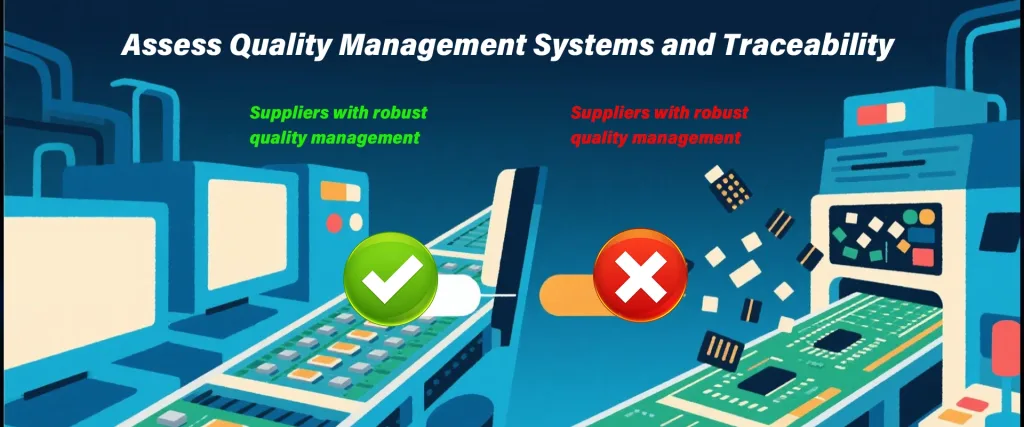
Suppliers with robust quality management systems deliver 5-10x lower defect rates than those without formal controls. The difference shows up immediately in your incoming inspection and assembly yields.
Every LED supplier on your approved vendor list should have:
Ask suppliers for these three performance indicators:
Three red flags that should disqualify a supplier:
❌ Cannot provide Cpk data for critical parameters
❌ No lot-level traceability system in place
❌ Refuses to share audit results or quality metrics
If conducting on-site audits, check for:
□ Calibrated test equipment with current certification stickers
□ Automated inspection stations (not just manual spot checks)
□ 8D corrective action process for customer complaints
Suppliers who view quality documentation as overhead rather than value aren’t positioned to support high-volume manufacturing.

Selecting a quality supplier is just the starting point. Ongoing performance tracking ensures they maintain standards and helps you catch problems before they impact production.
Monitor these four metrics for every LED supplier:
| Metric | Weight | Target | What It Measures |
| Incoming DPPM | 30% | <500 | Component quality at receiving inspection |
| Assembly defects | 20% | <0.5% | Tombstoning and other SMT failures traced to components |
| On-time delivery | 20% | ≥95% | Reliability for production planning |
| Technical support response | 10% | <24hr | How quickly they address issues |
Scoring system: 90-100 = Preferred supplier | 75-89 = Acceptable | Below 75 = Corrective action required
Formalize expectations with written agreements covering:
Strong supplier relationships reduce risk and improve responsiveness:
Suppliers who resist performance tracking or formal agreements aren’t committed to partnership-level relationships.
Cutting tombstoning defects from 3% to under 0.5% saves $15,000-$50,000 annually per production line. Quality SMD LEDs may cost slightly more upfront, but they deliver 15-40% lower total costs through fewer defects and less rework.
The five supplier criteria we’ve covered—termination quality, process compatibility, package design, quality systems, and performance tracking—prevent most tombstoning problems before components reach your assembly line.
Quality that prevents tombstoning:
Technical support when you need it:
Proven capabilities:
Contact us:
📧 marketing005@hqgled.com
💬 WhatsApp: +86 135-1027-0516
🌐 http://www.hqgled.com
Whether you’re troubleshooting current defects or planning a new product, our team can help you select components that deliver quality and reliability.