


Common Anode RGB LED vs Common Cathode RGB LED: 5050 SMD Pinout and Buying Guide
25 June, 2026

The wearable device market keeps growing, and LEDs are everywhere in these products. You’ll find them in fitness trackers showing your heart rate, smartwatches lighting up with notifications, and medical monitors displaying health data. But here’s the thing—getting LEDs to work properly in wearables isn’t straightforward. You’re dealing with limited space, tiny batteries, devices that touch skin, and constant movement. If you’re developing wearable products, you’ve probably run into at least a few of these integration challenges.
SMD (Surface Mount Device) LEDs are the go-to choice for wearables, and there are solid reasons why. Unlike traditional through-hole LEDs that need holes drilled in your PCB, SMD LEDs sit flat on the board surface. This saves space—something you definitely need in a smartwatch or fitness band.
Side-view LEDs work well when you need light coming out parallel to the board—think notification lights on the edge of a fitness band. Top-view LEDs are better when light needs to shine straight up through a display window. You can also choose single-color for simple indicators, bi-color for status changes, or RGB when you need full color control.
What specs actually matter: Look at brightness levels (measured in millicandelas or mcd), viewing angle, and power consumption. For wearables, you’ll typically want LEDs that run on 1-5mA and provide enough brightness for daylight visibility without killing the battery.

Wearables have minimal space. A smartwatch typically has just a few square centimeters for all components. Smaller LEDs like 0402 packages save space, but they may be too dim for users to see clearly.
Placement decisions matter because they affect manufacturing costs and assembly difficulty. Flexible or multi-layer boards offer more options, but careful planning is still essential.
Battery performance is critical. Users expect fitness trackers to last days, not hours. A single LED running at 20mA continuously drains a 200mAh battery in about 10 hours.
Most wearables use 100-500mAh batteries. A notification LED at 5mA for 5 seconds per hour uses 0.007mAh per alert. With frequent notifications, this adds up fast. Both LED brightness and on-time directly affect battery life.
Heat degrades LED performance and shortens lifespan. More critically, devices worn against skin must stay safe. ISO 13732-1 requires temperatures below 48°C for extended skin contact.
Small devices trap heat—the LED generates it, the case holds it in, and body heat adds more. Heat must be directed away from the LED and skin contact points.
Wearables flex constantly during wrist movement, exercise, and temperature changes. Solder joints on flexible PCBs crack under repeated stress.
Most fitness wearables need IP67 water resistance (1 meter immersion protection). Meeting this standard while maintaining LED visibility requires proper seals and enclosure design.
LEDs need to work in dark rooms and bright outdoor sunlight. Without proper diffusion, point-source LEDs create a bright center that fades at the edges. This uneven lighting looks poor quality and bothers users.

Power management directly impacts battery life and user satisfaction. These techniques significantly reduce LED power draw:
Thermal management prevents LED degradation and ensures skin safety. Follow these approaches to control heat in compact wearable devices:
| Method | Implementation | Benefit |
|---|---|---|
| PCB Heat Spreading | Copper pours under LEDs + thermal vias | Distributes heat across larger board area |
| Material Selection | FR-4 (standard) or metal-core PCBs (high heat) | Metal-core offers 5-10x better thermal conductivity |
| Heat Transfer Path | Thermal interface materials to housing | Larger housing surface dissipates heat to air |
| Power Derating | Reduce max power by 20-40% | Accounts for enclosed, body-contact conditions |
| Validation Testing | Thermal imaging + temperature measurement | Identifies hot spots in worst-case scenarios |
Wearables experience constant movement and environmental exposure. These design practices improve reliability:
Optical design affects both appearance and usability. These methods create uniform, controlled illumination:
Production quality directly impacts product reliability and cost. Key manufacturing practices include:
| Process | Best Practice | Purpose |
|---|---|---|
| Reflow Soldering | Peak 245-260°C, minimize time above 220°C | Prevents LED damage during assembly |
| Moisture Sensitivity | Check MSL ratings, pre-bake if needed | Avoids internal component damage from moisture |
| Optical Inspection (AOI) | Verify polarity, placement, solder joints | Catches reversed LEDs before final assembly |
| ESD Protection | Grounded straps, ESD-safe workstations, moisture bags | Prevents electrostatic discharge damage |
| Rework Procedures | Controlled heat, don’t exceed LED max temp | Enables repairs without component damage |
| Supply Chain | Qualify 2+ approved suppliers | Prevents production delays from availability issues |
| Aspect | Medical Devices | Fitness Trackers | Smart Clothing |
|---|---|---|---|
| What LEDs Do | Bio-sensing + device status | Notifications + alerts | Lighting effects + safety visibility |
| Biggest Challenge | Meeting FDA/CE regulations | Working in bright sunlight | Surviving washing machines |
| Brightness Level | Low to moderate | High | Moderate to high |
| Expected Lifespan | 5-10 years | 2-3 years | 1-5 years |
| Battery Life Goal | 1-7 days | 5-7 days minimum | Hours to days |
| Durability Focus | Consistent performance | Drops, sweat, impacts | Wash cycles, bending |
| Power Management | Balanced with accuracy | Extremely important | Depends on use case |
| Testing Requirements | Extensive validation | Outdoor and impact testing | Washability and flex testing |
| Technical Notes | Specific wavelengths needed (red/infrared for sensing) | Must be visible outdoors | Connects to flexible PCBs in fabric |
| Common Products | Heart rate monitors, pulse oximeters | Running watches, fitness bands | Safety vests, workout apparel, interactive fashion |
Medical wearables have stricter requirements. Heart rate monitors and pulse oximeters use specific LED wavelengths (usually red and infrared) for optical sensing, plus indicator LEDs for device status. These products need FDA clearance or CE marking, which means extensive documentation and testing.
Reliability standards are higher—medical devices typically target 5-10 year lifespans with minimal failures. You’ll spend more time on validation testing and need more robust designs from the start.
Fitness trackers prioritize outdoor visibility and ruggedness. Users want notification LEDs they can see during midday runs, not just indoors. These devices also take more abuse—drops, impacts, sweat exposure—so durability testing matters more than in other categories.
Battery life expectations are typically 5-7 days minimum for fitness bands, so aggressive power management is essential. Every mA your LED uses directly impacts that number.
Integrating LEDs into fabric creates unique challenges. The LEDs often connect to flexible PCBs that are then sewn or bonded into garments. You need to think about washability (can it survive a washing machine?), dry cleaning compatibility, and long-term durability through hundreds of wear cycles.
Innovative applications include safety apparel with LED lighting for nighttime visibility, interactive fashion pieces that respond to movement or music, and sports apparel with LED indicators for training feedback.

Micro-LED technology promises even smaller displays with lower power consumption. We’re talking about LEDs under 100 micrometers that could enable high-resolution displays in smartwatch-sized packages.
Truly stretchable LED technologies are emerging from research labs—imagine LEDs embedded in elastic fabric that can stretch 50-100% without damage. Energy harvesting integration could extend battery life by using body heat or movement to generate power.
AI-powered adaptive lighting systems will automatically adjust LED behavior based on user context—dimming during meetings, brightening during workouts, changing colors based on health metrics. We’re also seeing early work on biodegradable electronics for disposable medical wearables, reducing environmental impact.
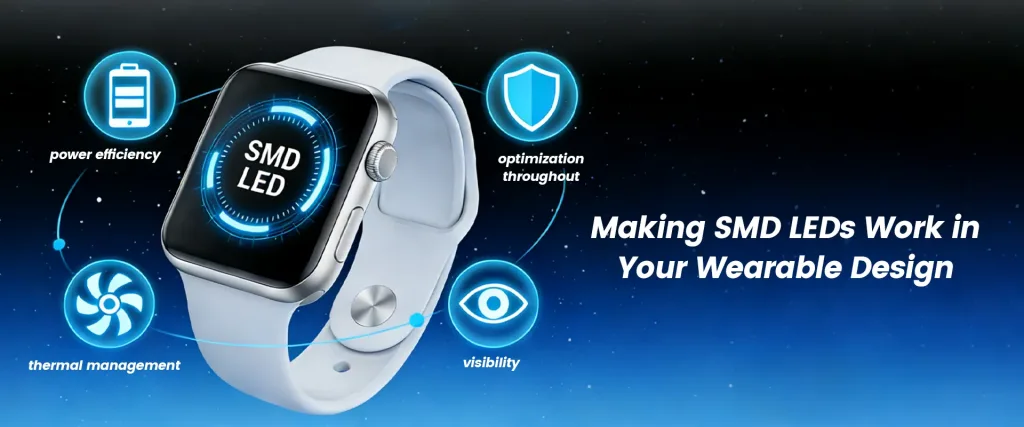
Getting SMD LEDs working properly in wearables means balancing multiple engineering challenges at once—power efficiency, thermal management, durability, and visibility. The solutions outlined here address the most common pain points you’ll encounter. Start conversations with LED suppliers early in your design process, work with optical design specialists when needed, and plan for continuous optimization throughout development. Your product will be better for it.
At HQG Optoelectronics, we understand the unique demands of wearable device manufacturing. With over 20 years of R&D expertise and 150+ engineering patents, we’ve helped product development teams across 35+ countries solve complex LED integration challenges.
What we offer for wearable applications:
Whether you’re developing fitness trackers, medical monitors, or smart clothing, our technical team can recommend the right LED components and provide guidance on power management, thermal design, and durability testing.
Ready to discuss your wearable LED project?
Let’s work together to create wearable products that deliver exceptional performance and reliability.
0603 and 0805 packages offer the best balance of size, visibility, and assembly reliability for most wearables. Go smaller (0402) only if space is extremely limited and you can ensure assembly quality.
Use PWM dimming at low duty cycles (10-30%), select ultra-low-power LEDs (1-5mA), minimize on-time, and implement automatic brightness adjustment based on ambient light.
Heat buildup in small enclosed cases can reduce LED efficiency and lifespan. Design copper pours for heat spreading, use thermal vias, and derate LED power ratings by 20-40% for body-worn applications.
Place LEDs on rigid PCB sections away from flex areas, use underfill for solder joint protection, choose flexible optical materials, and conduct thorough bend cycle testing (100,000+ cycles).
Work with major component distributors (Digi-Key, Mouser, Arrow) for prototyping. For production, establish relationships directly with LED manufacturers (Cree, OSRAM, Kingbright) and qualify backup suppliers for continuity.